Knee Cartilage Repair Surgeon
If knee cartilage damage is keeping you from the activities you enjoy, CartiHeal Agili-C may offer an advanced option for cartilage restoration. Schedule an evaluation with Dr. Ronak Patel to learn if Agili-C is right for your knee. Dr. Patel provides diagnosis and both surgical and nonsurgical treatment options for patients in Sugar Land, Pearland, and the Houston, Texas area who have damaged articular cartilage in the knee. Contact Dr. Patel’s team today!
Prefer to call? 832-500-8135
CartiHeal Agili-C for Knee Cartilage Repair in Houston, TX
Damage to the articular cartilage of the knee can be frustrating, especially if you are active and want to get back to your favorite sport without feeling pain in the knee. The bad news is that unlike many other tissues in the body, cartilage has a limited ability to heal itself after it has been damaged. When a cartilage injury does not respond to nonsurgical treatment, CartiHeal Agili-C (Smith and Nephew) may be an option for certain patients seeking knee cartilage restoration. This is an FDA approved product with a high-quality clinical trial.
Ronak Mukesh Patel, MD, is a fellowship-trained orthopedic sports medicine surgeon specializing in knee cartilage injuries and cartilage restoration in Sugar Land, Pearland, and the Houston, Texas area. His practice includes articular cartilage repair and transplantation as well as other advanced procedures for knee injuries.
What Is the CartiHeal Agili-C Implant?
CartiHeal is an FDA-approved, cell-free, resorbable implant designed to treat certain articular cartilage and osteochondral defects of the knee. An osteochondral defect involves damage to both the smooth cartilage covering the joint and the underlying bone.
Rather than permanently replacing the damaged area with an artificial surface, CartiHeal acts as a porous scaffold. The implant is gradually reabsorbed as the tissue grows into the treated area. According to the FDA, the implant is made from aragonite, a form of calcium carbonate derived from purified coral exoskeleton.
Some of the features that make CartiHeal different from other cartilage procedures include:
- It is an off-the-shelf implant and does not require harvesting cartilage cells for laboratory growth.
- Treatment can be completed in a single surgical procedure.
- It addresses the cartilage defect and underlying bone.
- It is biodegradable and designed to be gradually replaced by the patient’s own tissue.
- More than one implant can be used when appropriate.
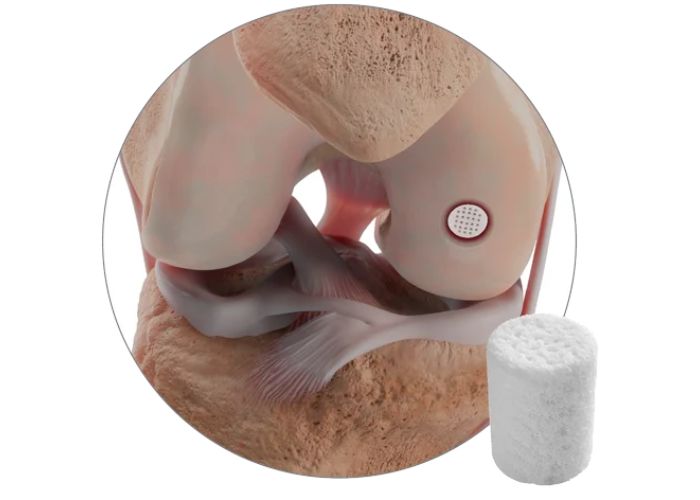
Photo Courtesy of Smith and Nephew
How Is the CartiHeal Agili-C Procedure Performed for Cartilage Damage?
The idea behind the procedure is fairly simple: remove the damaged portion of the joint surface, create an exact-sized opening, and place the CartiHeal scaffold into that area. During surgery, Dr. Patel first opens to view the damaged area of the knee and evaluates the cartilage defect. He then uses specialized instruments to prepare the treatment site. A cylindrical opening is created through the damaged cartilage and into the underlying bone. The CartiHeal implant is then inserted into this prepared opening. The number of implants placed depend on the size of the cartilage defect area.
The implant is placed using a press-fit technique, meaning it is designed to be pressed into the prepared area, fitting securely. There are no additional anchors or screws required to hold it in place. It does not sit on top of the damaged cartilage. The procedure involves the following:
- Identifying and evaluating the damaged cartilage.
- Preparing the cartilage and underlying bone at the treatment site.
- Creating a precisely sized cylindrical opening.
- Placing the CartiHeal implant into the defect.
- Confirming that the implant is properly positioned within the joint surface.
- Using additional implants when necessary to address eligible cartilage lesions.
How Does CartiHeal Help Repair Knee Cartilage?
Think of CartiHeal as a temporary framework that aids in the healing process. It does not act like a replacement part, but something that will be absorbed once the body has healed. Once the material is implanted, its porous structure provides an environment that encourages the body to produce tissue to fill the joint-surface defect.
The FDA describes the device as gradually reabsorbing into the body and being replaced by tissue, including bone within the underlying portion of the defect. The implant itself gradually resorbs over a year or more, although a patient’s overall recovery and clinical outcome can take a different course. This approach is designed to address two important parts of an osteochondral injury:
- The cartilage surface, which allows the knee to move smoothly.
- The subchondral bone, which sits directly underneath and supports that cartilage.
Who is a Good Candidate for CartiHeal?
CartiHeal has now expanded indications for cartilage patients. CartiHeal is available to use in patients with Kellgren-Lawrence grade 0-3 – most other cartilage procedures are not recommended for this level of cartilage problems. Patients in the CartiHeal studies had improvement even up to Kellgren-Lawrence grade 3. This has opened options for patients who are not candidates for other types of knee preserving cartilage restoration. Patients with bone on bone arthritis, Kellgren-Lawrence grade 4, are not candidates for CartiHeal.
Determining whether Agili-C is appropriate requires more than simply finding cartilage damage on an MRI. Dr. Patel will carefully consider the location and size of the defect. Other factors that need to be considered include the condition of the surrounding cartilage and bone, knee alignment and stability, patient symptoms, activity goals, previous treatment, and overall condition of the knee.
For some patients, another cartilage restoration technique may be more appropriate. Alternatives Dr. Patel offers can include microfracture or other marrow-stimulation techniques, OATS, osteochondral allograft transplantation (OCA), or cell-based cartilage restoration procedures such as MACI.
What Is Recovery Like After Agili-C Knee Cartilage Surgery?
Recovery is individualized because cartilage restoration involves more than allowing an incision to heal. The newly treated joint surface also needs time to recover and adapt. Patients should expect a structured rehabilitation program that may include:
- Temporary restrictions on weight-bearing.
- Gradual restoration of knee range of motion.
- Physical therapy to rebuild strength and mobility.
- Progressive increases in weight-bearing and activity.
- A staged return to exercise, running, or sports when appropriate.
The exact timeline depends on the size and location of the cartilage injury. The patient’s overall health and whether other procedures were performed at the same time as the restoration also have an impact on healing time.
CartiHeal Agili-C and Knee Cartilage Restoration in Houston
Cartilage restoration is not a one-size-fits-all procedure. The goal is to identify why the knee hurts, how much of the joint is damaged, and which treatment offers the best fit for that particular patient.
For patients with an appropriate focal cartilage or osteochondral defect, Agili-C provides another option within the growing field of knee preservation. Longer-term studies (Altschuler et al. AJSM 2026) have now followed patients to five years, with superior results compared to microfracture and debridement. Patients who underwent Agili-C implant treatment had better clinical outcomes and lower failure rate.
If you have persistent knee pain from a cartilage injury, Dr. Ronak Patel can evaluate your knee and discuss whether CartiHeal Agili-C or another cartilage restoration procedure may be appropriate for you. Dr. Patel treats patients in Sugar Land, Pearland, and the surrounding Houston, Texas communities.
What is the recovery time for CartiHeal Agili-C?
The recovery time can vary from patient to patient, but generally for weight-bearing lesions of the medial or lateral femoral condyles, patients are limited weight-bearing for 4 weeks and then allowed gradual progression of weight-bearing. During the first 4 weeks, they are using crutches but are allowed unrestricted range of motion in most cases.
For cartilage lesions of the trochlea, patients are allowed weight-bearing as tolerated with the knee in full extension in a brace. Range of motion is limited for the first two weeks and then allowed gradually.
The recovery is guided closely by Dr. Patel, as well as a specific physical therapy protocol given to the rehab practitioner. Adjustments may be made on a case-by-case basis.